Search over 27,600 MOOC courses
enter subject, university name or course name
Career Evolve is your partner in online learning and career development. Search our catalog of 28,000+ courses from over 21,000 top colleges and universities. Our partners have helped over 2 million students and continue to enroll over 30,000 students each month. Career Evolve provides you with access to free and affordable online training.

You can take courses in subjects varying from Philosophy to Computer Science or even Advanced Fiction Writing to Becoming a Physical Therapy Aide. Learn at your pace anytime and anywhere.
Career Evolve also integrates with LinkedIn to profile your achievements to potential employers.

Whether you are searching for micro learning from providers, such as Coursera, EdX or courses from leading Universities like MIT, Stanford and Peking University, Career Evolve is the answer for affordable learning and shrinking training budgets.

Invest in yourself with Career Evolve.

Discover your next learning opportunity from just one of our many Universities


Massachusetts Institute of Technology Georgetown University University of Queensland Boston University McGill University
Harvard University UC Berkeley Cornell University University of British Columbia Hong Kong University of Science and Technology
Showing posts with label dream job. Show all posts

Tuesday, 14 March 2017

Signup for the new MicroMasters in Cloud Computing


The University of Maryland University College has partnered with edX to deliver a new Micro Masters program in Cloud Computing.  The first course starts in May and is titled Cloud Computing For Enterprises.  You can learn more about this exciting new program at https://www.edx.org/micromasters/cloud-computing.

The exciting field of Cloud Computing has experienced explosive growth. This transformative technology has not only altered the way business operate, but it has also shaken up the traditional structure of the IT department and placed new demands on staff members who are faced with reinventing their own careers. With organizations rapidly moving their infrastructures and services to the cloud, jobs are growing at a breakneck pace, with many positions are left unfilled.
Gain an understanding of cloud technologies such as AWS, Azure, Google Cloud, OpenStack, and vSphere and how to leverage them to increase business productivity and effectiveness. In this Cloud Computing MicroMasters program, you will learn about Infrastructure As A Service (IaaS), Platform As A Service (PaaS), Software As A Service (SaaS), and other "X as a service" platforms. You will receive key foundational knowledge about legal and compliance issues, security and risk mitigation and how to follow industry standards and best practices. You will also gain hands-on experience in implementing, configuring and managing cloud technologies.
This applied, graduate-level program is designed for learners who want to enter or advance their careers in this exciting and well-paying field. IT professionals not already working with cloud technologies will gain a solid foundation while those with some cloud experience will gain a more in-depth understanding of other cloud technologies and other knowledge such as security, policy, and legal and compliance issues.


Job Outlook

  • More than half of US businesses now use cloud computing to reduce cost, increase flexibility, and increase agility. This number is expected to grow rapidly over the next few years. (Source: Forbes)
  • The federal government has a “Cloud First” mandate, which directs agencies to move IT infrastructure to the cloud. (Source: CIO.gov)
  • In 2015, over 3.9 million US jobs were affiliated with cloud computing, with many of them unfilled. (Source: Forbes)
  • Cloud Computing jobs are some of the hardest to fill in the industry. (Source: Burning Glass)
  • Job titles include: Cloud Engineer, Cloud Architect, Cloud Analyst, Network Architect, and Network Administrator.

Real Career Impact

Booz Allen Hamilton Logo
"The pace of today’s digital transformation requires us all to make a concerted effort to keep our technical expertise current. Programs like UMUC’s MicroMasters program in Cloud Computing is an excellent opportunity for people seeking to stay ahead of the curve, learning about cutting-edge cloud and modular technology solutions that are required to excel in a modern, 24/7 environment."
— Greg Wenzel , Executive Vice President for Booz Allen’s Digital Solutions group

What You'll Learn:

  • Cloud computing foundations and models
  • Types of cloud computing technologies (ie: AWS, Azure, IBM)
  • Methods for managing a cloud computing adoption/migration project
  • How to design a cloud computing infrastructure or service
  • Deployment and configuration of cloud computing systems
  • Insuring cloud security and mitigating risk
  • SaaS, PaaS and IaaS and other service platforms

MicroMasters Program Details

How To Earn The MicroMasters Credential
Complete and successfully earn a Verified Certificate in all 4 Cloud Computing MicroMasters courses.  Take Your Credential To The Next Level
Learners who successfully earn the MicroMasters Credential are eligible to apply to the Masters in Cloud Computing Architecture degree at University of Maryland University College, which is available fully online.

If accepted to the Masters in Cloud Computing Architecture program, the Cloud Computing MicroMasters program will count for 12 credits toward the Master’s degree (36 credits are required for graduation with the MS in Cloud Computing Architecture degree).

Understand cloud computing technologies and how they can increase business productivity and effectiveness.
Learn more about Cloud Computing for Enterprises
Learn methods for managing cloud computing projects and build an understanding of the various risks and compliance issues involved.
Learn more about Cloud Computing Management
Starts on August 2, 2017
Enroll Now in Cloud Computing Management
Learn how to design, configure, and manage a cloud computing infrastructure.
Learn more about Cloud Computing Infrastructure
Starts on October 4, 2017
Enroll Now in Cloud Computing Infrastructure
Learn how to identify security issues in the cloud and industry-standard techniques and procedures to prevent and mitigate risks.
Learn more about Cloud Computing Security
Starts on December 6, 2017
Enroll Now in Cloud Computing Security

Instructors

  • bio for ThomasUnderhill
    Adjunct Assistant Professor University of Maryland University College
  • bio for JeffTjiputra
    Chair of the Cloud Computing Architecture program University of Maryland University College

Monday, 13 March 2017

I have a typical manual tester resume. Can I find a job in DevOps?

It's all automation all the time in the DevOps world. So what does that mean for manual testers? Expert Gerie Owen suggests what testing skills to highlight.

You can find a job in DevOps. Although in both Agile and DevOps, there is a focus on automation and everyone is responsible for quality, your manual tester resume will still show many skills, especially in test design, exploratory testing and risk analysis.
 
Exploratory testing is another area to include on your manual tester resume. You can definitely contribute effectively here. As we all know, it is impossible to find all of the defects through automated testing. Manual testers, especially those who embrace the context-driven school of testing, can flush out defects to which the developer responds, "A user wouldn't do that."

Probably the most important role to include on a manual tester resume is in the area of risk analysis. Manual testers can become the champion of the customer by contributing to the development of the "definition of done" and determining whether or not the work on each user story meets that criteria. The manual tester has the opportunity to get involved on the business side, working closely with the product owner to fully understand and help develop the user story.
There are lots of roles and opportunities for manual testers on Agile and DevOps teams if they are willing to step out of their comfort zone and expand their horizons. You have lots of valuable skills to highlight on your manual tester resume that don't involve automation.

http://searchsoftwarequality.techtarget.com/

Friday, 5 August 2016

How to Get a Vacation Job


For students, the breaks between school semesters can be a period for relaxing and refocusing. But many people also use it as a time to earn extra cash. Whether you're searching for a summer vacation job, a job over winter break, a spring break job or a quick I'm-out-of-school-for-a-week-and-need-something-to-do job, you can find something that will keep you busy and your bank account happy.
Plus, looking for a work as a high school or college student can be good practice for the post-graduation job search that's around the corner. Break jobs can provide good experience and networking opportunities for your future career.
Finding a vacation job can be as easy as walking into the nearest fast-food restaurant or retail store and filling out an application. But if you're facing the possibility of a full-time job search in the future, you might want to take little more time and find a job that will be relevant to your career.
But where should you start your job search?
Lindsey Pollak, a career expert and author of " Getting from College to Career" advocates being "superstrategic" when seeking part-time or temporary employment. Career coach Judi Perkins encourages job seekers to find a job doing what they love, rather than taking any job that pays. Here are some tips to kick start your job search.
  1. Look for Hidden Opportunities
    Odds are you won't find your dream job over winter break, but you may find a stepping stone to your future career. Try to find a job related to your chosen field, suggests Pollak. "If you're interested in book publishing or journalism, work at the library. If you love fashion, work in a clothing store."
    An entry-level job can teach you essential skills and may introduce you to people who will be valuable in helping you find full-time employment later. Even if you can't find a job in, or related, to your field, give every opportunity your best effort. If you excel at a part-time or temporary job, you're more likely to be remembered by people who may have a connection to the job you want in the future.
    As Pollak reminds job seekers, "Even Madonna once worked behind the counter at Dunkin Donuts."
  2. Network, Network, Network
    In the job-search game, the saying, "It's not what you know, it's who you know" holds especially true. A personal referral or reference is the best way to get on the preliminary short list for an opportunity.
    "You can have the best résumé in the world, but if a recruiter never sees it, you'll never get the job you want," notes Pollak. Talk with friends, family, neighbors, classmates and even the guy next to you on the bus or at the beach. Every person you meet is a potential job lead, so make the most of your daily interactions.
  3. Think Beyond the Computer
    Social networking is an exponentially growing area for job seekers, but Pollak cautions that it shouldn't be your only avenue. "Never hide behind your computer screen," she warns.
    Ideally you'll want to blend online and in-person networking.Initiate a conversation online, for example, and then meet for coffee. Visit forums and blogs related to your field and interact with the participants. Build relationships rather than just look for contacts.
    "Remember, it's not always about you," Perkins warns. "Pay attention to people and think of ways you can help them by providing information or articles that might be of interest."
  4. Volunteer
    While you're looking for employment, spend some time volunteering. Philanthropic organizations often need extra help during the winter holidays. Volunteering not only gives you a chance to give back to the community, it introduces you to helpful people in a wide range of professions. You never know what a volunteer position will bring -- you might just meet your future boss while you're working in a soup kitchen.
    Pollak advises finding an opportunity in your field, if possible, not only to increase your network, but also as a trial run for your future career. "You may think you like working with children until you spend an entire summer volunteering at a nursery school."
  5. Open a Lemonade Stand
    An actual lemonade stand might not be your most profitable option, so instead think about the odd jobs you did when you were young. How can you leverage them to make extra cash?
    At Care.com, we see a huge demand for everything from child care to tutors to pet care during the winter and summer months. Take advantage of job postings and see how you can help out.
    During the hectic holiday season sitters are in high demand, so find a babysitting job and watch the kids while mom and dad go to the office holiday party. A family's regular nanny may take a vacation over the summer, so people are often looking for care. Did you ace algebra last semester? Brag a little and find a job as a tutor. Families who travel during typical vacation seasons might be interested in hiring a pet sitter to feed and walk their animals while they're gone. Busy households might appreciate the opportunity to hire a housekeeper for a few one-off cleanings, without having to commit to a weekly or monthly service. Ask local seniors if they need help mowing their lawn, shoveling snow or shopping for groceries.
    Think about what needs people have at this time of year and offer to perform them for a reasonable fee. You're only limited by your creativity.
  6. Brush up Your Résumé
    A résumé may not be necessary for a winter break or summer vacation job, but you might as well take advantage of your job-search mindset to get yours into shape. You never know when a temporary gig might turn into a career opportunity.
    Fancy fonts and colored or patterned papers are inappropriate for a résumé, but you can spruce things up in other ways. Try using bullet points to highlight specific accomplishments for each job, rather than a paragraph of responsibilities.
    "A résumé isn't a list of bland job descriptions and gobbledygook, generic, overly used phrases -- it's a document that tells your story and conveys who you are as an individual," advises Perkins. If you're looking at a variety of possible occupations, prepare a few alternate versions tailored to each job, highlighting your experience and skills for that particular market.
    Once you've finished up your résumé, check it for errors and then check it three or four more times. "Even a small typo can blow an opportunity," explains Pollak, "especially if you've included 'excellent attention to detail' as one of your skills." Ask a trusted friend or relative to evaluate content, clarity and correctness, or take advantage of your English teacher, an English major friend or your school's career center for help creating and reviewing your résumé.
Approach the search for a vacation job in the same manner as you'd approach your search for your lifetime career. You'll meet people who can help you find full-time work and learn skills that will benefit you in the future. You'll also have the chance to work through some of your interview jitters, and will be able to approach your future job search with confidence.
Jennifer Walker is a freelance writer living in Detroit. Her work can be found here.

Original post:  https://www.care.com/a/how-to-get-a-vacation-job-1301030538


Friday, 10 June 2016

3 Skills Employers Say They’re Desperate to Find

By Dominique Rodgers
Monster Contributing Writer
Everyone knows the really rare gems are the priciest. For a hiring manager, finding a candidate with all the necessary skills to do a particular job can feel like discovering a giant emerald right in your backyard -- incredibly rewarding and also highly unlikely.
 
As a job seeker, how can you position yourself to be that rare find? Add to your skills, of course. The key is choosing skills that employers value above others: It’s no surprise the most desired traits are a mixture of very specific tech skills and soft skills, or people skills. Here are three skills employers say they’re desperate to find.

Software Engineering and Development
 
"Employers today are desperate to find competent software engineers,” says Isaac Oates, CEO and co-founder ofJustworks, which offers online tools for payroll, benefits and compliance management. “iOS and the programming language Ruby on Rails are specifically in high demand, but engineers with strong fundamentals can pick up any language needed.”


If you would like to learn more then register for our upcoming online course "48 Hours To Better Manage Cloud For Your Business" from CareerEvolve.com!  

Email support@careerevolve.com to register today.
 
Oates says that so many businesses are utilizing mobile technology that the demand for engineers has simply outpaced the supply. There aren’t enough quality developers who are competent in iOS or Ruby on Rails, he says.
 
There are some tech skills that recruiters and employers are always looking for, says Raedawn Johnson, HR pro and recruiter with Solutionary, an IT security company. These forever in-demand skills include Linux and network security knowledge. Johnson also says it’s a struggle now to find people who are familiar with relatively new technologies, such as Hadoop.

Communication Skills
 
Hiring managers are looking for employees with the ability to communicate effectively with clients and colleagues at all levels in the organization, says Chris Fleek, director of HR services at Octane Recruiting. Fleek says this communication should include educating and managing staff as well as giving strategic presentations to executives.
 
“Managing up, the ability to present ideas and manage expectations with leaders in an organization, is a crucial skill in today’s fast-moving organizations,” Fleek says. “Instead of filtering information through layer upon layer within an org chart, team members must be comfortable pitching their research, work product or new idea directly to decision-makers.”

Need help with your communication skills? Check out local writing courses to improve your word-usage and Toastmasters to improve your public speaking.

Executive Presence
 
A mixture of poise, leadership, communication and industry knowledge -- these qualities, and others, make up executive presence. It’s a difficult quality to define, but recruiters, hiring managers and decision-makers say they know it when they see it.
 
They’re looking for someone with confidence who can represent the company or their specific team in customer visits or presentations with the board of directors, says Tiffany Kuehl, staffing manager at Honeywell and HR blogger at Performance I Create. “An individual who not only knows the industry inside and out, but can confidently facilitate a conversation without breaking down and crumbling the moment they are asked a tough question, is a candidate likely to have presence,” Kuehl says.
 
If you’re easily rattled, try to team up with a more polished mentor and get some tips on building your confidence and keeping your cool.

Thursday, 9 June 2016

5 Career Tips You Need to Ignore

By Catherine Conlan
Monster Contributing Writer
 
People are full of advice on just about every topic under the sun, and you’ve probably gotten a lot of work-related tips over the course of your career. But there are some nuggets that you’d be better off disregarding.
 
Consider these five career tips you need to ignore:

Ask for a promotion. 
 
It’s common to hear that you won’t get a raise or a promotion if you don’t ask for one. But PeopleNRG.com Managing Partner Lawrence Polsky says you shouldn’t ask; “not even at your annual review.” Instead, use your actions to show you’re a better leader.
 
“Learn the business inside and out, generate team results that your boss can't ignore and create the most positive, supportive, entrepreneurial spirit in the company,” he advises. “Then, when there is a need for a new leader, you will be asked. If you want to be promoted into a leadership role, and you think this advice is not realistic, then go get a new job in a new company where it is.”


If you would like to learn more then register for our upcoming online course "48 Hours To Better Manage Cloud For Your Business" from CareerEvolve.com!  

Email support@careerevolve.com to register today.

Keep your resume brief. 
 
You’ve probably been told to keep your resume to one page, but Michael Morgenstern, head of hiring at theExpert Institute, disagrees. “Your resume reflects why you are best qualified for and deserving of the proposed position. If you've had extensive work experience, don't sacrifice highlighting your skills, talents, and expertise just to cram everything onto one sheet of paper. Your resume should be tailored for the specific job you are applying for, and each job description should emphasize the talents that you have developed and will bring to the proposed role.”

A great resume will get you hired.
 
 
Marketing strategist Kyle Sexton says it’s vital to focus on using your resume to get an interview. “Your resume doesn't need to be in chronological order or even include every job you've had.”
 
“Your resume is a marketing tool,” he explains. “Use it -- along with your phone -- to get an interview. A great attitude and interview gets you the job, not the resume. Recognizing the different stages of the hiring process is critical to creating a tool that works well for its intended purpose.”

Send a post-interview thank-you note. 
 
Career coach Bettina Seidman says yes, a note after an interview is a good idea -- but not a thank-you note. “Send a strategic follow-up letter indicating why you are an excellent candidate,” she says. “It should be a response to the asked or un-asked question: why should we hire you?”

Follow your passion. 
 
This tip is “the most erroneous,” says Heidi Nazarudin, a former CEO turned style-and-success blogger. Many people have multiple passions or might not discover their true passions until later in life, “and sometimes these passions are just not viable as a source of income. The right question would be ‘What kind of life do I want to set up for myself?’”
 
For example, Nazarudin says she’s always been visually creative but knew being a successful photographer would be difficult. Instead, “I became an investment banker and pursued photography on the weekends,” she says. “My career as a successful investment banker allows me to indulge in my passion, and live the life I want.”

Wednesday, 8 June 2016

5 Small Career Moves That Can Lead to Massive Results


Sponsored by the Certified Corporate FP&A Professional Credential

The Certified Corporate FP&A Professional (FP&A™) designation, sponsored by the Association for Financial Professionals, defines universal principles and standards of practice. By earning the FP&A, you demonstrate your understanding of those complex processes, tools and best practices and are recognized as well-positioned to drive strategic business decisions at organizations. Set yourself apart.Learn more about the credential.

Getting ready for Trump or Clinton and their Presidential job

Final two horses head for the starting gate

Now presidential transition is in the air, with Hillary Clinton and Donald Trump each apparently having clinched their respective parties’ nominations. Just as a warm day in the fall smells differently than a warm day in spring, you can sense the change already.
This one isn’t going to bring moonlight and roses. The upcoming campaign instead brings to mind epic prize fights for which the late Mohammad Ali was famous: The “Thrilla in Manila,” the “Fight of the Century,” and “The Rumble in the Jungle.” Take your pick. It’s gonna be ugly.  Both of them know how to throw a punch.
Different as Trump and Clinton might be, they share a few similarities.
Both have firings  of “little people” prominently in their backgrounds — he from the TV reality show “The Apprentice,” she from her days as first lady and the White House travel office.  Think about that, all you senior executives who might be quivering in anticipation.
Both have had long and controversial public lives, so it’s not as if whomever you favor will shock you with what they do or say. Franklin Roosevelt, Jimmy Carter, even Bill Clinton and Barack Obama — their careers prior to the presidency were way shorter and more provincial.
Both are white and 70-years-old — the age Ronald Reagan was when he entered the White House. I guess 70 really is the new 50.
Both seem a little priggish. Neither likes to be crossed in a serious way. In watching and listening to both closely for a while now, my impression is that the real person in both cases lies hidden deep in a “heavily forested interior,” the phrase author and speechwriter Robert Sherwood used to describe an ultimately unknowable FDR.
Beyond that, I’d say the country will have a clear choice.
For federal agencies and the people working in them, transition is already underway, in a manner irrespective of which party will come in. Several groups are already at work on it, notably the Partnership for Public Service via its Center for Presidential Transition. Check out my interview with the Center’s David Eagles. He emphasizes the need to ensure continuity of the national security apparatus. Bob Tobias of American University points out, an incoming administration must possess the know-how to turn its ideas into tangible public policy. Perhaps Clinton has the experiential edge here.
Above all, whatever your political proclivities, keep ’em out of the office. Write the words “Hatch Act” in big block lettering on a 3 x 5 card, using a black Sharpie and red highlights. Prop it up at your PC so you can see it every morning when you get to work.

Tuesday, 7 June 2016

3 Ways People Mess Up the (Simple) Answer to "How Did You Come Across This Job Opportunity?"

I know what you’re thinking. Nobody messes this interview question up, right? I mean, it’s the easiest one you’ll ever have to answer during your job hunt. Ever. When I was recruiting, I approached it with the mindset of, “I’m going to ask the candidate to tell me how he found the gig just to break the ice.” Or, I’m going to bring this up to know which of my many methods actually led to a qualified candidate sitting in front of me. Never was it ever a trick question.
But I quickly learned that in a lot of ways, this one trips people up sometimes. And because I’ve seen some of the worst examples, here’s how you can avoid making the most common mistakes when talking about how you found the job.

1. You Feel Uneasy About Sharing That a Friend Referred You

I get it. Nepotism, right? Yuck. Nobody wants to feel like he got his foot in the door just because he knows someone at the company. What's worse than getting a little help from a friend? Dancing around the answer, hoping that you won't have to fess up to the fact that not only is your future on the line, your friend currently has a referral fee on the table for getting you an interview. 

What to Do Instead

I hate to sound so crass, but if you’re fortunate enough to know someone at a company you want to work for, just buckle up and tell everyone who asks you exactly how you found out about the job. A simple response like, “I was excited to find out about the job from my friend who works in [department]” is a perfectly OK response. In fact, it’s the only response you should be giving if this is the case.


If you would like to learn more then register for our upcoming online course "48 Hours To Better Manage Cloud For Your Business" from CareerEvolve.com!  

Email support@careerevolve.com to register today.

2. You Turn it Into a Monologue About Why This Is the Only Job You Want

Here's a perfect example of an interview question that only requires a short answer. All you need to do is tell the hiring manager where you found the darn job. But, all too often, candidates get so caught up in the moment that they end up turning it into a long-winded explanation of not only where they found the listing, but also why they couldn’t imagine working anywhere else. Sure, there’s nothing wrong with being excited about an opportunity, but when you’re going on and on about how you simple found the gig, it can be a huge turn-off for a recruiter. 

What to Do Instead

If you want to fold in a little tidbit about why you’re so excited about the job, that’s not a terrible idea. But, keep it short. Add your unique spin to a response along the lines of, “I found it on [wherever you found the job], and since I’ve been hoping to work for the company for a long time, I was excited to see the opening had become available.” That’s all you need. Seriously.

About The Author

Richard Moy is a Content Writer at Stack Overflow. He has spent the majority of his career in talent management, including a stint as a full-cycle recruiter and hiring manager. In addition to the career advice he contributes to The Muse, he also writes test prep and higher education marketing content for The Economist. Say hi on Twitter @rich_moy.

Tuesday, 3 May 2016

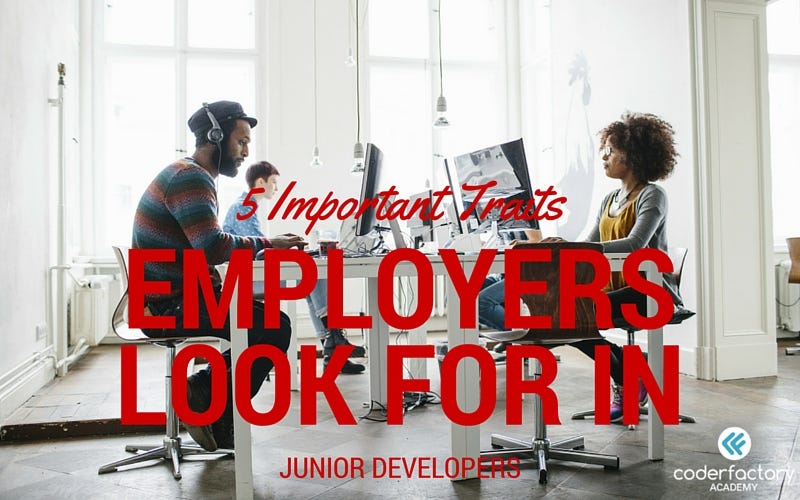
Tips to land your dream developer job


"Years ago, simply having the qualifications may well have been the deciding factor in whether you landed a career as a coder. But, as the 21st Century rumbles forward, more and more tech companies are focusing less on hiring people for what they already know, and more on what they can learn and bring to the company as a whole."

Coder Factory Academy describes their advice to land the dream developer job that you have pictured for yourself.  They identify that developers need to have a set of hard skills and soft skills, which means that they must be proficiently skilled in programming and have excellent communication and inter-personal skills.


The article essentially identifies that developers looking to land their dream job must work on the following soft skills to make themselves stand out from a crowd of comparable developers with equivalent hard skills or their technology strengths.

Some of the main soft skills that Code Factory Academy identify are:


Be nice


Good problem solving skills


Team work

If you would like to read the rest of the the career tips then be sure to read the article at https://medium.com/@coderfactory/5-must-have-qualities-employers-look-for-in-junior-software-developers-9067135174ef#.zaz4qa9d3.

If you want to continue to evolve your career and access free university courses then http:///www.careerevovlve.com is your source for information.


Find Enroll Learnbanner

Featured

Starting a Consulting 

Practice

Starting a Consulting Practice

Find out how you can earn income by sharing your training or knowledge with others.
PMP ® Certification Prep 1

PMP ® Certification Prep 1

Begin a well-paying career as a project manager by preparing to take--and pass--the PMP® certification exam.
How to Get Started in Game Development

How to Get Started in Game Development

Take steps toward a new career in game development by building a foundation to design games in a wide variety of genres for different audiences and platforms.
Accounting Fundamentals

Accounting Fundamentals

Gain a marketable new skill by learning the basics of double-entry bookkeeping, financial reporting, and more.
Conversational Japanese

Conversational Japanese

Whether you want to learn conversational Japanese for travel or just for fun, you'll find this course makes it easy and enjoyable for beginners to master the essentials of the Japanese language.
Introduction to QuickBooks 2015

Introduction to QuickBooks 2015

Learn how to quickly and efficiently gain control over the financial aspects of your business using this powerful software program.

Student Profiles